


AI-Ready Product Data: The New Foundation of Digital Commerce
When Product Catalogs Are No Longer Designed Only for People
For years, ecommerce catalogs have primarily been designed for shoppers browsing an online store: clear titles, images, descriptions, attributes, prices, and categories that help customers find and compare products.
Artificial Intelligence is changing that dynamic.
Consumers are beginning to use AI assistants and applications to ask questions, compare alternatives, and find products that match specific needs. Commerce notes that B2C and B2B buyers are already turning to AI applications to compare products, answer questions, and increasingly complete purchases.
This creates a new challenge: products no longer need to be understood only by people. They also need to be interpreted correctly by AI systems.
If an AI agent cannot find enough information to understand what a product is, who it is designed for, or why it is relevant to a specific request, it will have greater difficulty presenting that product as a suitable option.
As a result, product data quality is evolving from an operational requirement into a strategic component of ecommerce.
The Challenge Is Not More Data, but Better Data
A catalog may contain thousands of products and still lack the information required for emerging discovery experiences.
Commerce explains that product catalogs have traditionally been written for people browsing websites, rather than for AI agents that need to analyze and interpret product information at scale. Data enrichment is designed to help bridge that gap.
This means transforming existing information into richer, more consistent, and structured content.
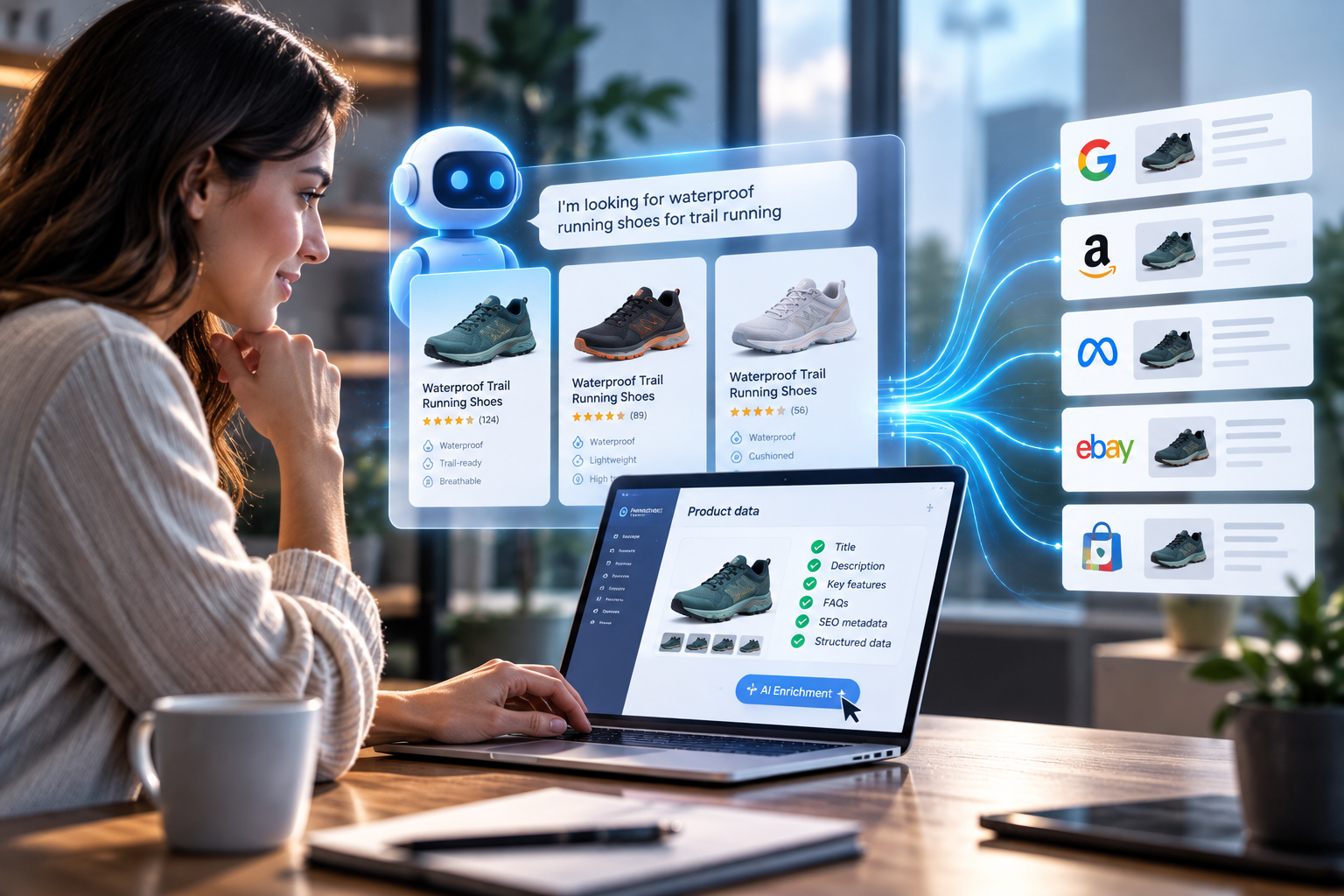
The new capabilities introduced by Commerce can generate and enrich elements such as titles, descriptions, key features, FAQs, and SEO metadata, along with structured information and question-and-answer fields that help generative experiences understand what a product is, who it is for, and why it may match a particular need.
The distinction matters. This is not simply about using AI to create more content. It is about improving the information that other AI-powered experiences will use to understand the catalog.
From Traditional SEO to AI-Powered Discovery
Product discovery is also changing.
A shopper may search for a product by name, but they can now also make a much more detailed request to an AI assistant—describing what they need, specifying conditions, and asking the system to compare different alternatives.
In this environment, structured and context-rich product data becomes increasingly important.
Commerce connects its new capabilities with AEO (Answer Engine Optimization) and GEO (Generative Engine Optimization), helping prepare product information for experiences where generated answers and AI agents participate directly in discovery.
For brands, the implication is significant. Optimizing a catalog is no longer only about making products visible within an online store or traditional search results. It also means preparing them for emerging environments where customers will discover and evaluate products.
One Product Data Foundation Across Multiple Channels
Maintaining consistent product information across multiple destinations has long been a challenge in digital commerce.
The same product may appear on a brand’s ecommerce site, Google, marketplaces, advertising platforms, social channels, and other destinations. When every channel relies on different information or requires manual updates, maintaining catalog quality becomes increasingly difficult.
Commerce’s approach is designed to allow the same enriched product foundation to support multiple experiences.
The company organizes the impact around four areas: reaching customers, operating the storefront, selling products, and building new digital experiences. Complete and consistent data helps products appear coherently wherever discovery takes place, while machine-readable structures make it easier for developers and AI systems to build new experiences around the catalog.
This becomes particularly important for businesses managing large product catalogs across multiple channels.
Feedonomics Enrichment: Improving Product Information at Scale
As part of the announcement, Commerce introduced Feedonomics Enrichment, designed for enterprise and multichannel brands that need to transform complex catalogs into consistent content prepared for different destinations.
The solution can work with information used across storefronts, search, and answer engines, including destinations such as Google, Meta, Amazon, and eBay, as well as emerging AI assistants and agent-based experiences. Content can also be adapted to a brand’s own taxonomy.
Quality control is another important component. Feedonomics includes an evaluation system focused on areas such as accuracy, consistency, and brand alignment, while identifying potential issues that may require review.
Commerce also announced analytics capabilities designed to monitor performance signals across onsite traffic and paid media, helping brands understand how enriched information performs throughout the customer journey.
Product content generation in Feedonomics Enrichment is currently available in English, with multilingual capabilities planned for a later stage.
BigCommerce Catalog Enrichment: Bringing AI Into Catalog Management
For BigCommerce merchants, the announcement also introduces BigCommerce Catalog Enrichment.
The capability allows merchants to select products and provide brand information to generate titles, descriptions, features, FAQs, SEO metadata, and structured fields directly within the BigCommerce control panel.
The goal is to help teams enrich even thousands of products without having to export their catalogs to an external tool and then import them again.
The generated results are also evaluated for accuracy, consistency, and alignment with the brand’s voice before the merchant decides whether to apply them to the catalog. This helps preserve human control over the information that is ultimately published.
Agentic Commerce: Preparing Ecommerce for a New Type of Buyer
These capabilities are part of the broader strategy Commerce describes as Agentic Commerce.
Commerce highlights four areas that matter for merchants in this new environment: becoming discoverable by agents, using agents within business operations, enabling conversion through conversational experiences, and building on open standards without creating unnecessary dependencies.
The underlying shift goes beyond adding Artificial Intelligence to an online store.
We are moving toward an environment where a shopper can express a need in natural language and allow an application or AI agent to research alternatives, compare product characteristics, and assist with the decision.
In this environment, a brand’s ability to participate begins long before the conversation itself—it begins with the quality of its data.
How Sphere Can Help Businesses Prepare for This Evolution
At Sphere IT Consulting, we see this transformation as a natural evolution of ecommerce toward environments where data, platforms, integrations, and Artificial Intelligence are increasingly interconnected.
Our experience working with technologies within the Commerce ecosystem, including BigCommerce, Feedonomics, and Makeswift, enables us to address different digital commerce needs—from ecommerce platforms and product data management and distribution to digital experiences and integrations with the systems that support business operations.
For businesses, preparing for Agentic Commerce does not mean immediately adopting every available AI technology. The first step can be much more fundamental: assessing whether product data is complete, consistent, structured, and sufficiently enriched to perform across both current channels and emerging AI-powered discovery experiences.
At Sphere, we help organizations move forward in this evolution by integrating platforms, optimizing information flows, and developing digital experiences designed for a commerce landscape increasingly driven by data and Artificial Intelligence.
Because in this new environment, if AI cannot understand a product, it will be much harder for it to recommend it.
Source
Commerce. Commerce Introduces Data Enrichment for BigCommerce and Feedonomics to Power Agentic Commerce. Published September 29, 2026.