

Enterprise AI enters a new phase
Enterprise AI is undergoing a decisive transformation. Today, the evolution of foundational models and systems capable of reasoning, generating insights, and operating as autonomous agents has opened up new opportunities for organizations.
However, the real challenge is not accessing advanced models, but implementing them with security, governance, and scalability. In this context, Snowflake’s recent advances and its strategic alliance with OpenAI consolidate a clear vision: artificial intelligence must be integrated directly into the enterprise data platform; therefore, AI can no longer be an external layer, but must be part of the operational core of the business.
Snowflake + OpenAI: Intelligence Integrated into the Data Core
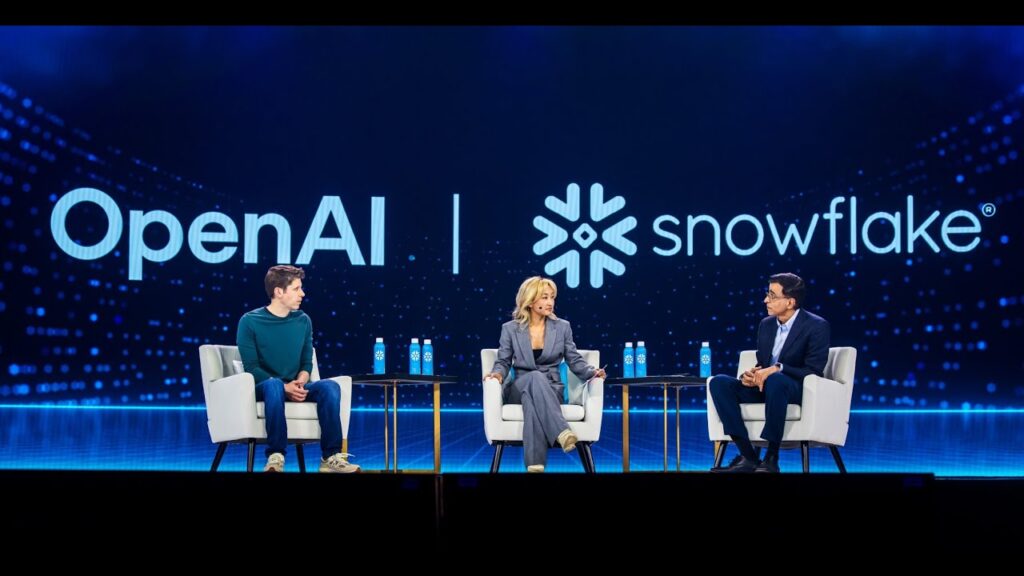
The collaboration between Snowflake and OpenAI allows advanced AI models to operate natively within the AI Data Cloud. This eliminates the need to move data to external environments and reduces risks associated with security and compliance.
The advantages are clear:
- Security and governance by design
- Role-based access control (RBAC)
- Scalability without data duplication
Instead of treating AI as an additional layer, companies can incorporate it as part of their strategic infrastructure.
From data to decisions in natural language
With capabilities such as Cortex and Snowflake Intelligence, users can interact with business information using natural language and generate tables, graphs, and analyses that are ready to share.
This speeds up decision-making, democratizes access to insights, and reduces exclusive dependence on technical teams. Enterprise AI is no longer complex, but rather a direct enabler of organizational productivity and efficiency.
Snowflake Postgres: Architectural modernization and simplification
The availability of PostgreSQL within Snowflake allows transactional and analytical loads to be executed on the same platform; this unification reduces the complexity of the technology stack and improves operational efficiency.
For organizations, this means:
- Less technology fragmentation
- Greater control and centralized security
- Architectures ready to scale
Modernization no longer means adding tools, but rather consolidating capabilities.
The New Business AI-Based Operating Model
Enterprise AI is redefining the operating model of organizations. It is not just about automating isolated processes, but rather incorporating intelligence directly into data architecture and business flows. This new approach means that AI is governed from the design stage, integrated into core systems, and aligned with strategic objectives. Decision-making becomes more agile, teams work with greater autonomy, and information flows with traceability and control.
The AI Data Cloud represents this evolution: a platform where data, models, and governance operate in a unified manner. Companies that adopt this model will not only improve their efficiency, but will also be better positioned to innovate continuously and competitively. In an increasingly data-driven environment, the advantage will not be in using AI, but in integrating it correctly into the heart of the business.
How Sphere IT Consulting drives Enterprise AI
At Sphere IT Consulting, we help organizations design and implement modern architectures based on Snowflake, integrating artificial intelligence, governance, and scalability. From data strategy to the implementation of secure and productive AI solutions, we turn technological innovation into a tangible competitive advantage.
Enterprise AI is no longer optional. Companies that integrate intelligence strategically, securely, and in a structured manner will lead the next decade. If your organization is looking to operationalize AI with control, scalability, and a vision for the future, we are ready to accompany you.
This analysis is based on recent announcements and official communications from Snowflake published in its corporate newsletter. The interpretation presented incorporates a strategic vision focused on the evolution of the AI Data Cloud and its impact on modern enterprise architecture.